【Agile FAQ, Part 14】What Does a Scrum Master Do? They Look Like They Have Nothing to Do (Plus: Will AI Replace SMs?)
Back to Top
To reach a broader audience, this article has been translated from Japanese.
You can find the original version here.
Thank you for reading this article. I am Tomohiro Fujii, a member of the Agile Group.
Following on from the previous article about the PO, this is the second discussion of roles: the Scrum Master (SM). While the problem with POs was that they “do not show up,” the problem with SMs is that “they are here, but no one knows what they are doing.” They may sound similar, but their structures are the opposite.
The Agile FAQ series index is here 🫱 Agile FAQ
Previous article 👈 【Agile FAQ, Part 13】The PO Is Too Busy to Come to the Team
Question
#Our Scrum Master facilitates various meetings, but I do not really know what they do beyond that. They do not write code, and honestly, they look like they have nothing to do. We are also hearing comments from the administrative department such as, “Isn't a dedicated Scrum Master a luxury?” What, ultimately, does an SM do?
Answer
#If you look inside the questioner's mind, you will usually find three questions lined up there.
- What does an SM do besides acting as a meeting facilitator?
- Are there not some SMs who really do nothing?
- How should we respond when someone says, “Having a dedicated person is a luxury”?
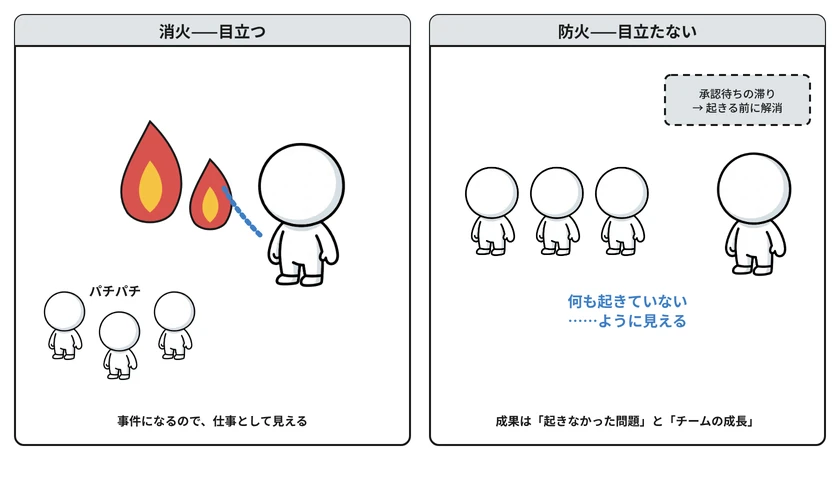
Much of a good SM's work is structurally very difficult to see. Because its outcomes take the form of “problems that did not happen” or “team growth,” the smoother things are going, the more idle the SM appears. Using that as an excuse, there really are SMs who do nothing but facilitate meetings. At one point, obtaining certifications became a trend, as though the number of certified people indicated an organization's level of agility. In many workplaces, these “mass-produced SMs” (not mass-produced GMs) participated only in events and did nothing but facilitate.
To help correct this situation in a better direction, this article covers both “how to see invisible work” and “how to identify SMs who are not functioning.” And for the question, “Isn't that a luxury?”, let us answer by adding the work of fire prevention to the organization's vocabulary.
Have You Ever Heard “SMs Are Servant Leaders” and Tilted Your Head?
#“An SM is a servant leader who serves the team.” “An SM is not a manager.” These are standard phrases in training, but they often leave listeners with questions like these.
- What specifically does serving mean? Is it ultimately just arranging meetings?
- If they are not managers, what are SMs responsible for?
- Once a team can operate autonomously, will it no longer need an SM?
I thought the same when I first took on the SM role. Now, I would answer this way: The SM's work is fire prevention, and fire prevention does not stand out. The substance of service is proactively removing things that hinder the team. The responsibility is maintaining a state in which the team can produce results through Scrum. And even autonomous teams have work for an SM, but the center of gravity shifts outward. However, simply saying this would probably sound like nothing more than defending SMs who tend to appear idle. Let us first look at the forms SMs tend to take, and then provide the basis for this argument.
SM Anti-Patterns
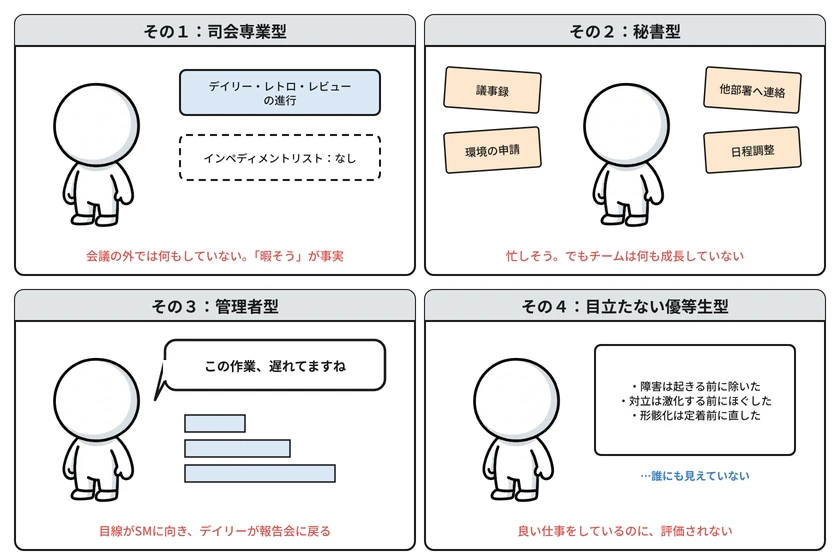
#There are several anti-patterns among SMs who “look like they have nothing to do.” If you are an SM reading this, please use it as a self-check.
Type 1: The Meeting-Facilitation Specialist — This type defines the role as “facilitating meetings and coordinating schedules.” They run Daily Scrums, Retrospectives, and Reviews, but do nothing outside the meetings. There is no list of impediments, and they do not remember ever engaging with anyone outside the team. With this type, the impression that they “look idle” means they really are idle.
Type 2: The Secretary — This type takes on all of the team's miscellaneous chores and looks busy, but the team does not grow at all. Meeting minutes, environment requests, communication with other departments—they mistake service for “doing things on behalf of others.” A team that cannot function without the SM is created, and that becomes proof of the SM's value.
Type 3: The Manager — The opposite of “SMs are not managers,” this type tracks progress, assigns tasks, and presses people about delays. They bring the project manager style from their previous workplace directly into the role. The team's attention turns toward the SM, and the report-meeting-style Daily Scrum discussed in Part 6 is reproduced under this type of SM.
Type 4: The Invisible High Achiever — This type is actually doing good work, but no one can see it. Impediments are removed before they occur, conflicts are eased before they escalate, and hollow routines are corrected before they become entrenched. The better things go, the more it appears from the outside that “nothing is happening.” There is a good possibility that the SM in the opening question is this type. Distinguishing them requires the perspectives described later.
What Makes Invisible Work Invisible
#One assumption runs through all four types: “Work means visible tasks.” By this measure, an SM without visible tasks is idle (the meeting-facilitation specialist); increasing visible tasks counts as a contribution (the secretary); returning to the visible work of progress management is enough (the manager); and invisible work is not evaluated (the invisible high achiever). The four types are the result of being measured by this yardstick, or trying to conform to it.
With this yardstick in mind, let us answer the three questions.
First, what specifically does service involve? If we make a good SM's day visible, it might include activities like these:
- Observing the team's conversations, picking up concerns that people seem reluctant to voice, and putting them on the agenda
- Discussing an approval process that is making the team wait with the responsible department, and proposing shorter lead times or a review of requirements
- Meeting one-on-one with the PO to communicate that ambiguity in the backlog is creating rework for the team
- Investigating why an improvement raised in a Retrospective has stalled for two Sprints, and removing the impediment
- Noticing, earlier than anyone else, signs that “the Daily Scrum has recently started turning back into a report meeting”
What these all have in common is that their outcomes do not become incidents. Firefighting stands out, but fire prevention does not. Most of an SM's work is fire prevention. Furthermore, because an SM's outcomes appear as changes in the team's behavior, there is a time lag. “The team has become able to solve problems on its own” is an achievement that takes months, but if you look only at that moment, it can seem as though “the SM is doing nothing.”
Next, what are SMs responsible for? They are responsible for maintaining a state in which the team can produce results through Scrum. Not responsibility for progress, but responsibility for the state in which things that obstruct progress have been removed. Therefore, an “SM who only facilitates meetings” is not fulfilling their responsibility. Here are several perspectives for distinguishing this. They can be used both by the team and as self-checks for the SM.
- Is there an impediment list, and is it moving?: Is there a list of the specific delays affecting the team—for example, the waiting time for approval, rather than the approval process itself? Are items regularly added and resolved? If the list does not exist, or the same items remain on it for months, fire-prevention activities are not being carried out.
- Is the team's way of working changing through Retrospectives?: Rather than the execution rate of Try items, the number of changes to the team's way of working is the SM's primary outcome metric (see Part 7).
- Are they engaging outside the team?: An important part of the SM's job is bringing problems that cannot be solved within the team to the organization. When was the last time the SM negotiated with someone outside the team?
- Is the team growing?: Compared with six months ago, has the range of problems the team can handle on its own expanded? Has its dependence on the SM decreased?
If these questions yield nothing, the problem is not “the role of SM,” but “the definition of that SM's work.” I recommend reading this article together and discussing the role starting with a redefinition of it.
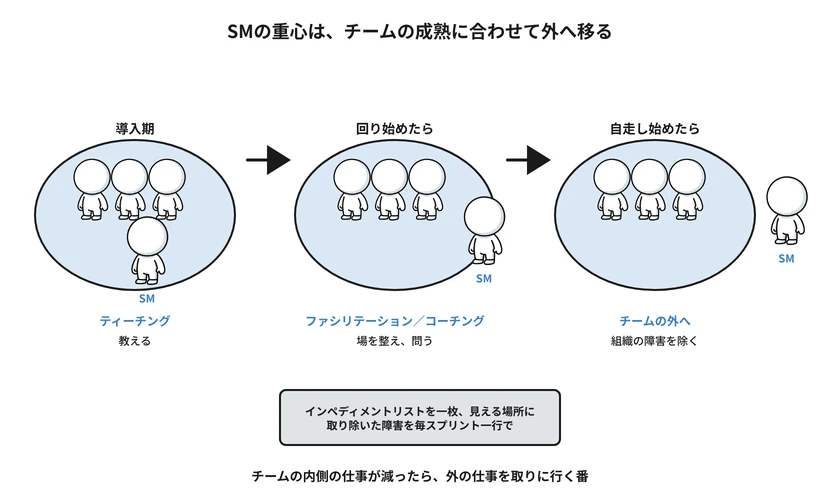
And then, does an autonomous team no longer need an SM? The work inside the team decreases. That is the completed form. However, at that point, the center of gravity shifts outside the team—to removing organizational obstacles and engaging with other teams and administrative departments. The period when an SM “looks idle” is often the timing of this shift.
Why is “work means visible tasks” the only available yardstick? Because organizations already have existing measures for evaluating people's work—the amount they produce, the number of cases they complete, utilization rates. SM work does not fit any of these. Problems that were prevented cannot be counted, and even if the team grows, there is no measure that can record it as the outcome of the individual SM's contribution. Things that cannot be measured by existing yardsticks appear as though they are “not working.” It is not that anyone is acting in bad faith. The yardstick is simply outdated.
So, once again, what does a true SM do? From the perspective of empiricism, an SM is the person who ensures that the team's inspection and adaptation keep functioning.
Transparency — Ensuring that things hindering the team are visible as an impediment list, rather than existing only in the SM's head.
Inspection — Seeing earlier than anyone else whether events have become hollow rituals, whether the team's way of working is changing through Retrospectives, and whether the team is growing.
Adaptation — Removing obstacles, engaging with the organization, and changing one's own involvement to match the team's maturity.
Viewed in this light, the hollowness of the meeting-facilitation specialist becomes clear. There is no transparency (no list), and both inspection and adaptation have been reduced to merely running events. Redefine the SM from “the person who runs meetings” to “the person who removes obstacles so that inspection and adaptation can keep working.” Once this is redefined, the following prescriptions follow naturally.
Prescription
#From here on, we will discuss tools. However, if it ends with “we made a list,” all you have done is add another document for the secretary type. After trying these measures, assess them by whether impediments have been resolved and whether the team can handle more problems without the SM.
First, create a single impediment list and place it somewhere visible
Before changing anything, make it visible. If invisibility is the problem, making it visible is the first move. Put what is currently blocked and what the SM is working on into a single document, and place it where the team can see it. Report even a single line each Sprint on “impediments removed during this Sprint.” This is not for the SM's self-promotion; it is so the team and organization recognize that the work of “fire prevention” exists. If you can add a conversion of removed obstacles into “waiting time reduced” or “days of delay prevented,” you are one step away from explaining cost-effectiveness as well (the record of PO response waiting time discussed in Part 13 can be used directly as material for this). For example: “We consolidated approval routes and eliminated waiting time equivalent to six people for three days.” If you can say this one sentence, the cost-effectiveness of a dedicated SM is on the table for discussion.
And visualization is only complete when someone reads it. Management and executives should treat items on this list whose roots lie on the organizational side—slow approvals, environmental constraints—not as “the team's problems,” but as “homework the organization must take on.” That is the moment when the work of fire prevention truly becomes visible.
Shift the center of gravity according to maturity
An SM's work changes in accordance with the team's maturity. During the introduction phase, teaching is the focus. Once things begin running, the focus shifts to arranging the setting (facilitation—handling the setup and flow so that discussion moves forward) and asking questions (coaching—asking questions that lead people to their own answers rather than giving them the answer). Once the team begins operating autonomously, the center of gravity shifts outside the team—to removing organizational obstacles and engaging with other teams and administrative departments. If work within the team has decreased, it is time to seek work outside it. This is also where the secretary type is escaped: reduce “doing it on their behalf” and replace it with “enabling them to do it themselves.”
If the role is concurrent, agree on what you will give up
For organizations that say, “A dedicated person is a luxury,” a concurrent role may be a practical solution. However, a concurrent SM will structurally have their fire-prevention activities reduced first. Development tasks have deadlines; fire prevention does not. If you make the role concurrent, the team and organization must explicitly agree to the trade-off that “observation and engagement outside the team will become thinner,” and accept the risk of being more likely to miss signs of hollowing out. Unplanned, gradual concurrent assignment is the most dangerous option.
Why Has This Question Been Repeated for 30 Years?
#Anything that cannot be measured by existing yardsticks appears as though it is “not working”—and this structure has not changed for 30 years.
That is why the reason for the SM role's existence is questioned every time the generation changes. When it is questioned, “making invisible work visible” is not only about protecting SMs themselves; it is also the steady, important work of adding the value of fire prevention to the organization's vocabulary. Is the impediment list moving? Is the team's way of working changing through Retrospectives? Has the SM recently negotiated with someone outside the team? If you ask these three questions, you can determine whether the SM is doing the work of fire prevention.
Bonus: Will AI Replace Scrum Masters?
#Recently, there is a question I have begun receiving often in training: “AI can take meeting minutes and send reminders. Don't we no longer need SMs?” Let us answer from the perspective of this article.
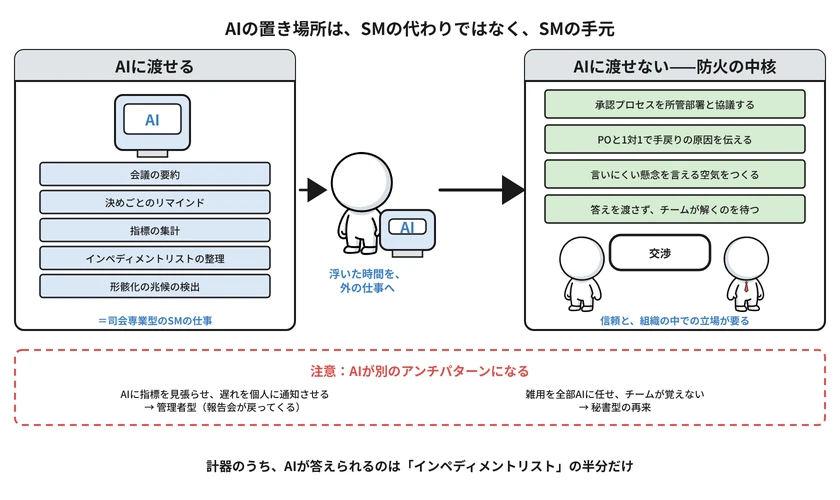
There are certainly tasks AI can take on. Meeting summaries, reminders about decisions, aggregation of velocity and waiting times, and organizing the impediment list. This is most of what the meeting-facilitation specialist SM used to do. The kind of SM AI can replace is the one who “looks idle.” In that sense, AI is the strongest rebuttal to mass-produced SMs.
AI can also help at the entrance to fire prevention. If you have it read Daily Scrum records, it may detect signs that “things have recently started returning to report meetings” earlier than a person would. However, how to return that signal to the team and what to change are the work that comes after that.
On the other hand, the core of fire prevention cannot be handed over to AI. Discussing the approval process that is making the team wait with the responsible department. Telling the PO one-on-one that ambiguity in the backlog is causing rework. Creating an atmosphere in which concerns that people seem reluctant to voice can be voiced. Waiting without giving answers until the team becomes able to solve problems itself. None of these can work without trust with the other party and a position within the organization. AI may notice signals, but it cannot negotiate with someone outside the team and make them consolidate approval routes.
And we must be careful that AI does not become another anti-pattern. If AI monitors metrics and sends individuals notifications about delays, that is precisely the manager-type SM. The team's attention turns toward AI notifications, and the report meeting returns. If all miscellaneous chores are delegated to AI and the team does not learn its own way of working, it is the return of the secretary type.
Therefore, the right place for AI is not in place of the SM, but at the SM's side. Delegate aggregation and recordkeeping to AI, and devote the freed-up time to the work of engaging outside the team. Think of AI as bringing forward the shift in the autonomous team's SM center of gravity that we saw in the previous section. Among this article's gauges—whether the impediment list is moving, whether the team's way of working has changed through Retrospectives, and whether the SM has recently negotiated with someone outside the team—AI can answer only half of the first one.
Next time: “Even though we are told to self-organize, the leader ends up deciding everything.”
The Agile FAQ series index is here 🫱 Agile FAQ
Previous article 👈 【Agile FAQ, Part 13】The PO Is Too Busy to Come to the Team