How to Differentiate 'Problem Solving' and 'Task Achievement'? – Defensive and Offensive Thinking Methods for New Project Managers
Back to Top
To reach a broader audience, this article has been translated from Japanese.
You can find the original version here.
Introduction
#In a previous article we learned the importance of distinguishing “facts” from “truths.” Have you ever found yourself at a crossroads while driving a project forward?
“Should I address the problem in front of me?”
“Or should I aim for a higher goal?”
Identifying the essence of your dilemma can be the turning point for success. In this article, we’ll introduce two thinking approaches you can switch between depending on the situation.
They are the Problem Solving approach and the Task Achievement approach.
This article is part of a series for new project managers
- Part 1: Starting with the Difference Between “Problems” and “Tasks” (Introduction to Issue Management)
- Part 2: Detective-Style Management – How to Discern the Truth? (Thinking & Observation Edition)
- Part 3: Starting with the Difference Between “Problems” and “Risks” (Introduction to Risk Management)
- Part 4: Diagnosing “Problems” with SOAP and Prescribing “Tasks” (Problem Solving Edition)
- Part 5: Mindset Switching Between “Problem Solving” and “Task Achievement” (Thinking Switch Edition)
👉 If you’re new to this series, we recommend starting with Part 1.
"Problem Solving" vs "Task Achievement": Criteria for Distinguishing the Two Approaches
#In this article, for new project managers (PMs), we will explain:
- The differences and decision criteria for the two approaches
- How to proceed with and leverage each approach
- The “axis of thinking” for switching between them depending on the situation
In manufacturing and on-site improvement fields, these are sometimes organized as:
- Problem Solving = a defensive approach of “eliminating the bad”
- Task Achievement = an offensive approach of “creating the good”
Understanding this distinction will help you see what to prioritize right now. So how do you apply the two approaches?
The answer is simple: the relationship between reality and goals is the key.
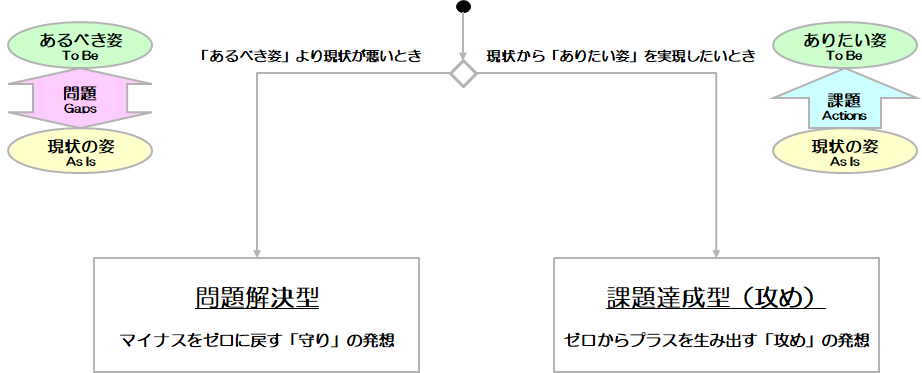
It might be hard to grasp with words alone. Let’s examine each one in detail.
Strengthening the Project’s "Defense": The Problem Solving Approach
#When Is the Problem Solving Approach Necessary? Three Common Situations
#Imagine these scenarios on the ground:
- An unexpected bug is found in a newly released service…
- Delays or cost overruns start to appear in the planned budget or schedule…
- You receive customer complaints, or sales targets are not met…
These situations can be painful—they represent a negative state worse than the “ideal situation.” The goal of the Problem Solving approach is to bring that negative state back to zero.
Basic Steps of the Problem Solving Approach: Strengthening Defense
#This approach proceeds like a detective uncovering the cause of an incident. Pay attention to each step.
On-site, the principles of “3 Gen,” “3 Soku,” and “3 Tetsu” are crucial. They help you accurately understand problems, respond swiftly, and see things through.
Keeping these principles in mind will make your problem handling more effective.
| Step | What to Do | Purpose (Why) |
|---|---|---|
| ① Identifying the Problem | Accurately grasp the facts of “what is happening.” | To remain objective and avoid being swayed by emotions or speculation. |
| ② Cause Analysis | Repeat “Why?” and “Why?” to dig into the root cause. | To implement effective measures and prevent the same failure. |
| ③ Planning Countermeasures | Consider a combination of quick fixes and permanent solutions. | To cut off the problem rather than merely apply a temporary fix. |
| ④ Execution and Verification | Execute the countermeasures and carefully monitor their effectiveness. | To ensure the problem is truly resolved through to the end. |
A Brief Note: What are 3 Gen, 3 Soku, and 3 Tetsu?
- 3 Gen: Genba (the actual site), Genbutsu (the actual thing), Genjitsu (the actual situation). Important for correctly understanding the problem.
- 3 Soku: Sokuji (immediacy), Sokuza (instantness), Sokuō (immediate response). Promotes swift action.
- 3 Tetsu: Tettō (thoroughness from start to finish), Tetsubi (thoroughness through to the end), Tettei (complete thoroughness). Represents a commitment to see things through to the end.
Shifting the Project to "Offense": The Task Achievement Approach
#When Is the Task Achievement Approach Effective? Future-Oriented Ways to Grow Your Project
#Consider these kinds of challenges:
- Launching a new service or feature that doesn’t yet exist on the market!
- Taking on the challenge of building a system that dramatically boosts team productivity!
- As a PM, achieving your own skill development and career goals!
For such challenges, frame your goals through the lens of QCDSME. This allows you to evaluate project outcomes from multiple angles.
In the Task Achievement approach, it helps you define what kind of value to create. With these indicators, it becomes easier to build consensus within the team.
A Brief Note: What is QCDSME?
It’s an acronym for Quality, Cost, Delivery, Safety, Morale, and Environment.
By managing these elements in balance, you can evaluate a project’s success.
Basic Steps of the Task Achievement Approach: Accelerating the Offense
#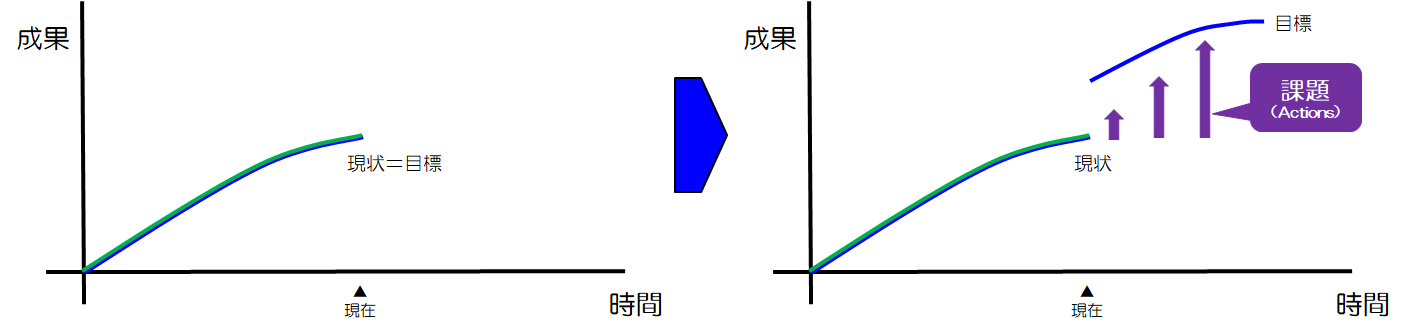
In the Task Achievement approach, you start by refusing to be satisfied that the current state merely meets the goal—you raise the goal higher than it is now. As shown in the diagram above, by elevating the goal, you intentionally create a gap between the goal and the present state. This gap becomes the “task” that pushes the project to the next level.
| Step | What to Do | Purpose (Why) |
|---|---|---|
| ① Goal Setting | Establish a concrete goal—“by when, what, and how”—using criteria like SMART. | To align the entire team and ensure everyone aims in the same direction. |
| ② Current Situation Analysis | Clarify the gap between the set goal and the current state (i.e., the task). | To make clear what needs to be tackled. |
| ③ Planning | Break down the path to the goal into milestones and tasks. | To move forward steadily with a feasible plan. |
| ④ Execution and Improvement | Execute the plan and, while monitoring progress, refine your approach. | To increase the success rate and steadily move toward the goal. |
A Brief Note: What is SMART?
It’s a goal-setting framework composed of five elements: Specific, Measurable, Achievable, Relevant, and Time-bound.
Summary: Switch Your Thinking Gears and Grow as a New PM
#- The Problem Solving approach is a defensive method of bringing negatives back to zero.
- The Task Achievement approach is an offensive method of creating positives from zero.
These two approaches aren’t about superiority; think of them as gears in a car. When trouble hits a project, calmly reset with the Problem Solving approach; once things stabilize, envision the future with the Task Achievement approach.
A PM who can flexibly switch mindsets is someone the team can trust.
Practical Tip: “What Am I Facing Right Now?”
#When you’re uncertain on the ground, ask yourself:
- “Is this work meant to close the gap with the ideal state?”
- “Or is it a challenge toward the desired state?”
Keeping this question in mind will clarify your next step.
Over five installments, we have run this series for new PMs, explaining the differences between “problems” and “tasks,” how to make situational judgments, and thinking methods for both response and achievement.
This series comes to a close here. Thank you for reading.
From next time onward, we will move a bit away from content exclusively for new PMs and introduce material for all PMs tackling more complex project challenges. Please look forward to it!