I took the AWS Certified AI Business Strategist (AIB-C01) exam! Overview of the newly established Business certification and my passing experience
Back to Top
To reach a broader audience, this article has been translated from Japanese.
You can find the original version here.
Introduction
#This is a record of me taking the new exam purely out of curiosity.
Recently, I took the highly anticipated beta exam newly added to AWS Certifications: AWS Certified AI Business Strategist (AIB-C01, beta exam code: AB1-C01). In this article, I will cover an overview of the newly introduced exam, my study preparations, my real impressions on exam day, and the pass/fail result.
Due to the Non-Disclosure Agreement (NDA), please understand that I cannot discuss detailed exam questions or specific question items.
Also, the content of this article is based on information as of October 2026 (when the beta exam was taken).
About the Exam
#AWS Certified AI Business Strategist (hereinafter, AI Business Strategist) is a certification aimed at business leaders, DX promotion personnel, planning roles, and others. It comprehensively assesses knowledge in creating business value using AI and generative AI technologies, strategic decision-making, and governance promotion.
Until now, AWS certifications like Solutions Architect and various specialties have mainly focused on infrastructure setup and implementation technologies (How). In contrast, this exam belongs to the newly established Business category. A major feature is its focus on the business strategy perspective of "Which challenges to apply AI to and how to make investment decisions and advance internal controls (Why / What)."
- Exam Overview
- Exam Code: AIB-C01 (Beta exam code: AB1-C01)
- Category: Business (newly established category)
- Exam Duration: 170 minutes + 10 minutes (pre- and post-exam surveys, etc.)
- Number of Questions: Approximately 85 (Beta exam)
- Passing Score: 700 (scale of 100–1,000)
- Exam Fee: ¥8,250 (tax included; half-price vouchers cannot be used)
Since this is a beta exam, the exam duration, number of questions, and other details may change after the official release.
Exam Domains (from the Exam Guide)
#The main domains listed in the exam guide are as follows:
- Domain 1: AI Fundamentals and Business Literacy
- Basic concepts of machine learning and generative AI, identifying applicable business challenges
- Differences between traditional predictive AI and generative AI (foundation models) and their impact on business
- Domain 2: AI Strategy and Business Value Creation
- Formulating business cases for AI adoption and methods for evaluating ROI (return on investment)
- Trade-off decisions between in-house development (Build) and adopting external services or existing models (Buy)
- Establishing quantitative and qualitative KPIs (Key Performance Indicators)
- Domain 3: AI Governance and Responsible AI Leadership
- Promoting responsible AI (fairness, transparency, accountability, privacy protection)
- Mitigation of hallucination risks and designing Human-in-the-Loop interventions
- Compliance with intellectual property rights, copyrights, and industry regulations
- Domain 4: Organizational AI Readiness and Transformation Enablement
- Establishing an organizational structure (AI Center of Excellence: CoE) that supports enterprise-wide AI adoption
- Employee upskilling and change management (overcoming resistance to change)
- Scaling strategies from pilot operations to enterprise-wide deployment
Registration
#After seeing the beta exam announcement, I registered through the certification portal site.
The beta version of the newly established AWS certification exam offers a special price of ¥8,250 (tax included) and is a valuable opportunity to experience the latest trend questions early. I adjusted my schedule and secured a testing slot at the test center this time as well.
What I Prepared
#Since this certification does not test coding or detailed infrastructure configuration commands, I focused on business-perspective AI strategy and governance in my preparations.
1. Thorough Reading of the Exam Guide
#First, I read the official Exam Guide to check the scope. It clearly states that "implementing Python code" and "detailed infrastructure settings" are out of scope, so I decided to focus my studies on business decision-making and strategy development scenarios.
2. AWS Skill Builder
#On AWS's official learning platform, AWS Skill Builder, I reviewed and utilized the official practice question set and related materials.
- Official Practice Question Set: AWS Certified AI Business Strategist (AIB-C01 - Japanese)
The official practice question set (in Japanese) is provided and is ideal for grasping question trends, scenario problem formats, and how answer choices are presented in advance. - Exam Preparation Category (AIB-C01 / AB1-C01)
I used materials such as generative AI courses for business leaders ("Generative AI for Executives") and resources on Responsible AI to build foundational concepts.
3. Reviewing Official Whitepapers and Blogs
#I reviewed AWS official documents and frameworks regarding business value and governance.
- AWS Cloud Adoption Framework (CAF) for Artificial Intelligence
- Official Guidance on Responsible AI
- Amazon Bedrock / AWS Generative AI Service Use Cases (industry-specific use cases in finance, healthcare, retail, etc.)
Observations During Preparation
#Through my studies, I identified several important perspectives that differ from traditional engineer-focused exams:
- Focus on "Is it a sound business investment?" rather than "Is it technically possible?"
Fine-tuning the latest foundation models is not always the correct answer. The emphasis is on first experimenting with prompt engineering or RAG to determine if the ROI, operational costs, and risks justify the investment. - Clear decision criteria for Build vs Buy
The exam clearly asks you to distinguish when to adopt SaaS or managed services (such as Amazon Q) versus building in-house models or pipelines (Amazon SageMaker / Bedrock). - High emphasis on Responsible AI and risk management
Governance design addressing legal and ethical risks companies face in production—such as hallucination countermeasures, bias mitigation, copyright protection, and data privacy—is a major pillar of the exam. - Importance of organizational and personnel change management
Beyond merely introducing tools, themes such as setting up a CoE (Center of Excellence), internal training, and phased PoC promotion—essentially, how to embed AI within an organization—are also key.
On Exam Day
#I took the exam at my usual test center.
- Length and content of questions
Occasionally there were longer questions that filled an entire screen or page, but none asked about complex technical configurations or parameter settings. The focus was on decision-making for expansion strategies on how to spread AI within a company and on corporate control and governance rule advancement. Therefore, if you regularly work in project management, business planning, or DX promotion, you should be able to choose the correct answers naturally from the context. - Time allocation and condition
The exam time is set to 170 minutes, which is relatively generous. On the day, due to lack of sleep from the night before, I ended up dozing off and finished just as time was up. However, since there were no code comprehension or complex calculation questions, I felt that with adequate rest and focus, one could maintain a pace of under one minute per question.
Exam Results
#That evening, I received the score report and passed successfully.
Additionally, I also earned the Early Adopter digital badge, a benefit for beta exam passers.
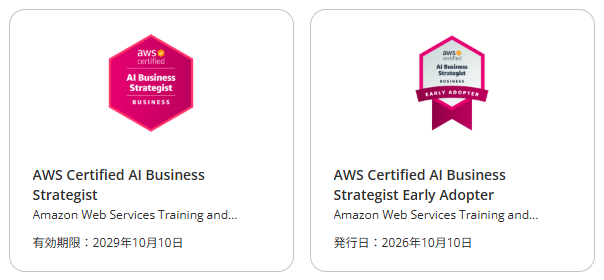
As I anticipated, there were no questions on detailed AWS CLI commands. This exam tests your fundamental understanding of "Can you make appropriate AI utilization decisions within a business context?" and "Can you build a responsible promotion framework?"
Prerequisite Knowledge That Applies (Affinity with Other AI Certifications)
#What I found after taking the exam is that knowledge from other cloud providers or existing AI certifications provides a significant advantage. In particular, if you have knowledge or learning experience with the following certifications, you can smoothly grasp the intent behind the questions and find the exam much easier:
- AWS Certified Generative AI Developer - Professional (AIP-C01)
Deep insights into Bedrock selection criteria, guardrails, and compliance design - AWS Certified AI Practitioner (AIF-C01)
Foundation of AI/ML basic concepts and use cases on AWS - Google Cloud Certified Generative AI Leader (GAIL)
Shared philosophy on generative AI adoption, ROI evaluation, and organizational deployment from a business leader's perspective - Microsoft Certified: Azure AI Fundamentals (AI-901)
Common basic principles of Responsible AI (fairness, transparency, privacy protection, etc.) - Generative AI Passport (GUGA)
General foundational knowledge common to social/business contexts, such as AI literacy, intellectual property rights, copyright, and risk management
By the way, I have passed all of the above except for the "Generative AI Passport." As a result, the governance and use-case knowledge I gained from each exam naturally stayed with me, allowing me to make smooth decisions even on scenario questions I encountered for the first time.
Conclusion
#- Ideal for non-engineers as a new "Business" category
For PMs, DX promoters, planners, and consultants who serve as a bridge between business and AI, this certification provides an optimal framework to prove systematic knowledge. - A perfect opportunity for engineers to elevate their perspective
For engineers who tend to focus on "how to implement," this exam is a great chance to organize a higher-level business perspective on "why create it," "is the investment justified," and "how to embed it in the organization." - Earn the Early Adopter badge by taking the exam early
There is a unique excitement in the launch phase of a new certification, making this an engaging challenge for both business leaders and engineers involved in AI promotion.
That's a brief record of my exam experience— I hope it helps those considering taking this certification moving forward.