Evolving ET Robocon with AI: Four Years to Silver Model and the Next Challenge
Back to Top
To reach a broader audience, this article has been translated from Japanese.
You can find the original version here.
Introduction
#In this article, I introduce the trajectory of my four-year involvement in ET Robocon.
Last year, I participated in the Basic Class (formerly known as the Primary Class) and stepped into a new development style incorporating AI.
This summarizes how my experiences accumulated over the years and led to last year’s achievements.
I hope you’ll stick with me until the end.
A One-Line Summary of Four Years of Activity
#Over these years, I layered new challenges: Design (UML) → Implementation → Real Machine Control → Team Management → AI Utilization.
- Year 1: Learned the basics in the Entry Class
- Year 2: Model evaluation grew from B to A
- Year 3: Deepened understanding through supporting juniors
- Year 4: Entered a new phase with a Basic Class challenge + AI utilization
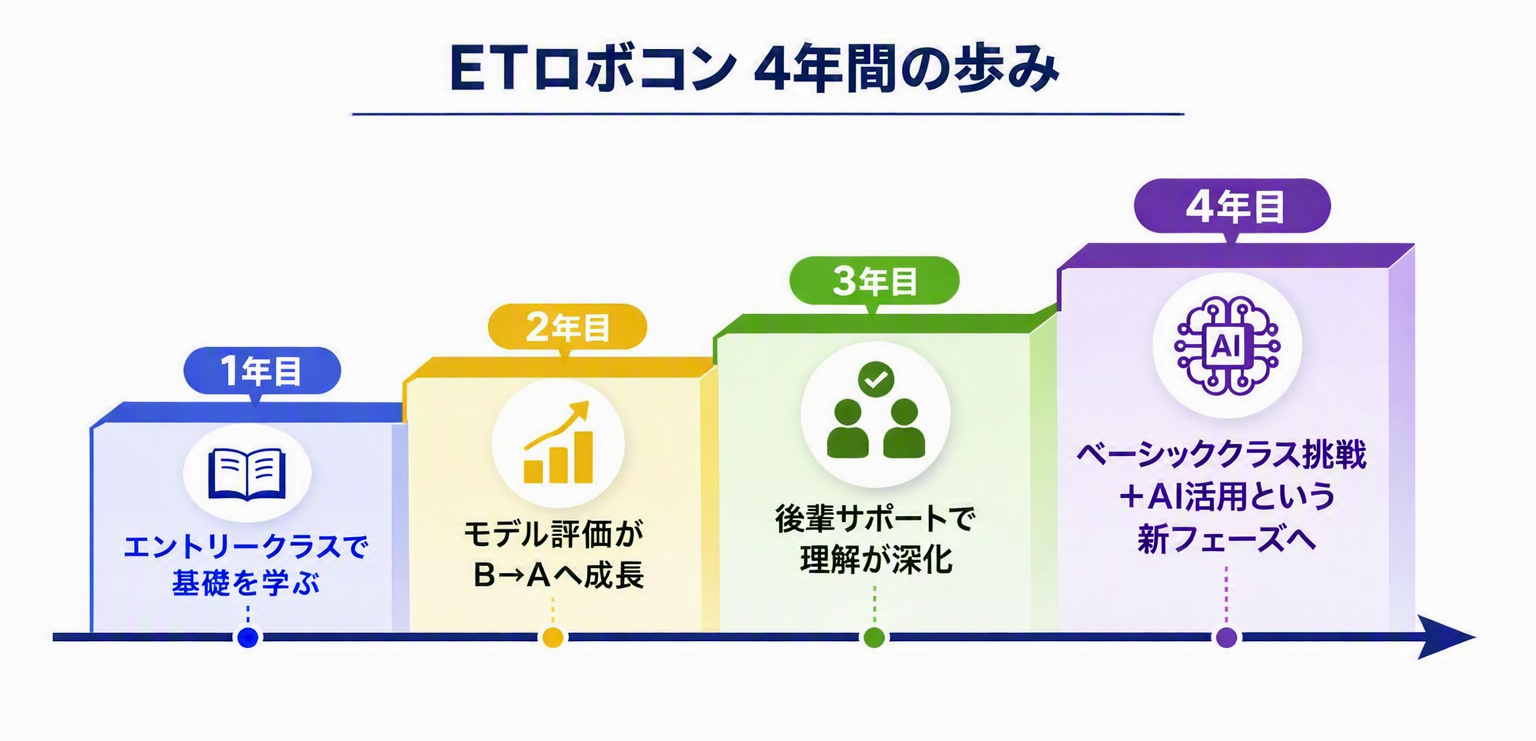
4-Year Journey of ET Robocon
I feel that over these four years I have grown significantly both in technical skills and teamwork.
1. Motivation to Join: Reliving That 'Moment' When the Robot Moves
#My reason for starting ET Robocon lies in my technical college Robocon experience.
The exhilaration when the robot I had built through trial and error moved exactly as intended for the first time.
I wanted to experience again as a working adult the joy of achieving something with my peers through technology, and that led me to participate.
2. What is ET Robocon: A Software-Centric 'Educational Robocon'
#ET Robocon is a robot contest aimed at educating participants in embedded software technology.
While typical Robocons focus on hardware ingenuity and mechanical design, ET Robocon is characterized by
evaluating both software design (UML) and run performance.
For more details, please visit the official ET Robocon website.
ET Robocon has been held since 2002 and celebrated its 25th anniversary in 2026. It has been recognized for its contribution to training embedded engineers, and has even received the Minister of Economy, Trade and Industry Award.
Objectives of ET Robocon
#- Training embedded software engineers
- Hands-on PBL (Project-Based Learning) practice including analysis, design, and control modeling
- Providing an educational environment where beginners and veterans can learn from each other
Nationwide Tournament Structure
#ET Robocon holds regional tournaments in 12 areas across the country,
and top teams advance to the national championship.
Three Classes to Choose From According to Level
#-
Entry Class (Simulator Division)
For beginners. Participate using a simulator to learn the link between design and implementation. -
Basic Class (Physical Division)
Formerly Primary Class
For beginners to intermediate participants. Learn model expressiveness and team development. -
Applied Class (Physical Division)
Formerly Advanced Class
For practitioners and advanced participants. Incorporate advanced elements such as control technology and AI, learning development while visualizing the entire system.
A Robocon Competition Decided by Software
#Hardware is provided via a common commercial kit,
and teams are evaluated based on design (model sheet) + run performance.
The reliability, consistency, and expressiveness of the model sheet are crucial,
and rankings are determined by combining run time and bonus time for clearing difficult sections.
Extensive Technical Training Events
#- Technical education sessions (online/offline)
- Modeling workshops
- Test runs
- Networking events at regional tournaments
- Result presentations at the championship
It provides a valuable forum where companies, students, and educators can discuss common themes.
Participants and Achievements
#- Tournaments held in 12 regions nationwide
- A total of 4,095 teams / 22,700 participants (official figures)
Due to its high educational effectiveness, it is widely used in corporate training and university courses.
Our Relationship with the Contest
#Mamezou not only participates in the contest but also supports it as a district Gold Sponsor,
actively engaging in technical education initiatives as a company.
3. Year-by-Year Reflections on Participation
#Year 1: Entry Class Challenge (+ Advanced Class Support)
#In my first participation, I felt my way forward but worked on model creation and run tuning.
I also supported the Advanced Class, experiencing firsthand the high level of the upper class.
Year 2: Model Evaluation Grew from B to A
#Focusing on modeling led to an evaluation improvement from B to A.
It was a year in which I strongly felt the importance of design.
Year 3: Understanding Deepened Further Through Junior Support
#Building on the model that received an A evaluation, I took on the role of explaining to juniors “how to improve the model.”
Teaching others deepened my own understanding and helped raise the entire team’s level.
4. Last Year’s (Fourth Year) Efforts: Basic Class Challenge and the New Weapon of 'AI Utilization'
#Last year marked a significant turning point.
I moved a step beyond the Entry Class and took on the Basic Class.
Furthermore, I also ventured into a development style that actively leverages AI.
Leveling Up the Model
#To handle complex control, I enhanced the precision of state transitions and class structures, greatly deepening my design-stage thinking.
AI-Driven Model Refinement
#Using AI as a "design review partner":
- Generating suggestions for model improvements
- Checking for omissions
- Optimizing UML representations
...all of which helped improve design quality.
Mastering Robot Control with Real Hardware
#There was much to learn unique to real hardware—acquiring sensor values, PID control, line following, and so on—which deepened my understanding of embedded control.
AI-Assisted Coding
#I also adopted a development style using AI for tasks such as code generation and refactoring suggestions.
Results
#The model won the Silver Model (2nd place).
Although there were still issues in the run, the breadth of technical challenges was the greatest to date, making this a significant experience that will carry into the next year.
5. Future Outlook: Further Deepening the Four Pillars of UML × Real Hardware × Control × AI
#This year, building on last year’s experiences, I plan to further strengthen the four pillars of design capability with UML, real hardware control, control technology, and AI utilization.
As part of this effort, with the goal of further leveling up model creation, I am challenging myself to the Applied Class.
Although running posed challenges last year, this year I have prepared the course environment and have been fully engaging in raising our control technology level.
Regarding AI utilization, I position it as an essential technology supporting the entire development process in areas such as:
- Model improvement
- Code generation
- Design review
In Closing
#ET Robocon is a place where you can learn a wide range of technologies through hands-on experience, including modeling, coding, real machine tuning, and AI utilization.
I intend to continue treasuring the thrill of seeing the robot move and the satisfying feeling of building up technologies.