Continuously Striving to Find Better Ways: Learning All the Wisdom Needed for Agile at the Sushi Bar Counter
Back to Top
 アドベントカレンダー2025
To reach a broader audience, this article has been translated from Japanese.
You can find the original version here.
This is the article for Day 18 of the Mamezou Developer Site Advent Calendar 2025.
Introduction
#Hello. I’m Daisuke Kishimoto from the Agile Group in the Business Solutions Division. With the advances in generative AI, I feel more and more that businesses need wisdom rather than knowledge. It’s been almost a quarter-century since the Agile Manifesto was published. Some say “it’s still just beginning,” others “it’s already taken for granted,” or even “by now it’s outdated,” but I believe what’s important is that we continue to strive to find better ways.
Frameworks like SAFe, Less, Scrum@Scale, and DA—various approaches to scaling agile—have each evolved. While the terminology and focus areas differ somewhat, they respect and reference each other, so when you look at them in abstraction you’ll find many similarities. Incorporating insights from fields like economics, psychology, and more, they keep striving to find “better ways,” giving the impression of being an eternal beta version.
Still, some teams struggle with Scrum events becoming mere formalities. When you think not only about the names and practices like “Agile,” “Scrum,” and “Lean,” but also ask “For what purpose?” and “What will make people happy?”, you find many similar scenarios outside of software development, and discovering and referencing those can spark insights and inspiration.
So this time, I’d like to think about agile in the context of a sushi restaurant. This isn’t suited for beginners learning the basics of agile, but I hope it can serve as a source of insights to expand the mental toolbox of Scrum Masters and agile coaches. Previously, in Continuously Striving to Find Better Ways: Evolution Works Better with Freedom, I introduced some examples where “anything looks agile,” but please be aware that this discussion may trigger a symptom where you find yourself thinking about agile every time you visit a sushi restaurant.
人生に必要な知恵はすべて幼稚園の砂場で学んだ
#It’s a somewhat older book, but many of you probably remember its catchy title, right? In fact, I think we learned a lot in the kindergarten sandbox—about life (and about agile). A timebox until nap time. Didn’t things like this happen?
In the sandbox, “I want to build a mountain~,” “That looks fun, I’ll make one too~,” “Me too~”—everyone did mob work.
“I’ll pour water,” “Okay, I’ll compact the mountain,” “I’ll dig a tunnel~,” “Then I’ll dig from the other side”—self-management.
Retrospective: “Our way of compacting the sand was too weak so it collapsed,” “Sorry I poured too much water.”
Then planning what to do next: “So next time shall we build a bigger mountain and dig two tunnels?” “Can’t wait~♪”
And then we drank milk and everyone took a nap♪
All the Wisdom Needed for Agile Can Be Learned at the Sushi Bar Counter
#Do you all like sushi? When you go to a sushi restaurant, do you order a nigiri set at a table, or do you sit at the counter and order piece by piece?
For example, if two people sit at a table and look at the menu photos and prices for the Matsu Set, Take Set, and Ume Set, and choose one, each set clearly defines the number of pieces, types of toppings, and price per person, and everything is served together (released) at once. That feels somewhat waterfall-ish, doesn’t it? Since it all comes at once, if the first piece you eat is disappointing, there’s nothing you can do about it.
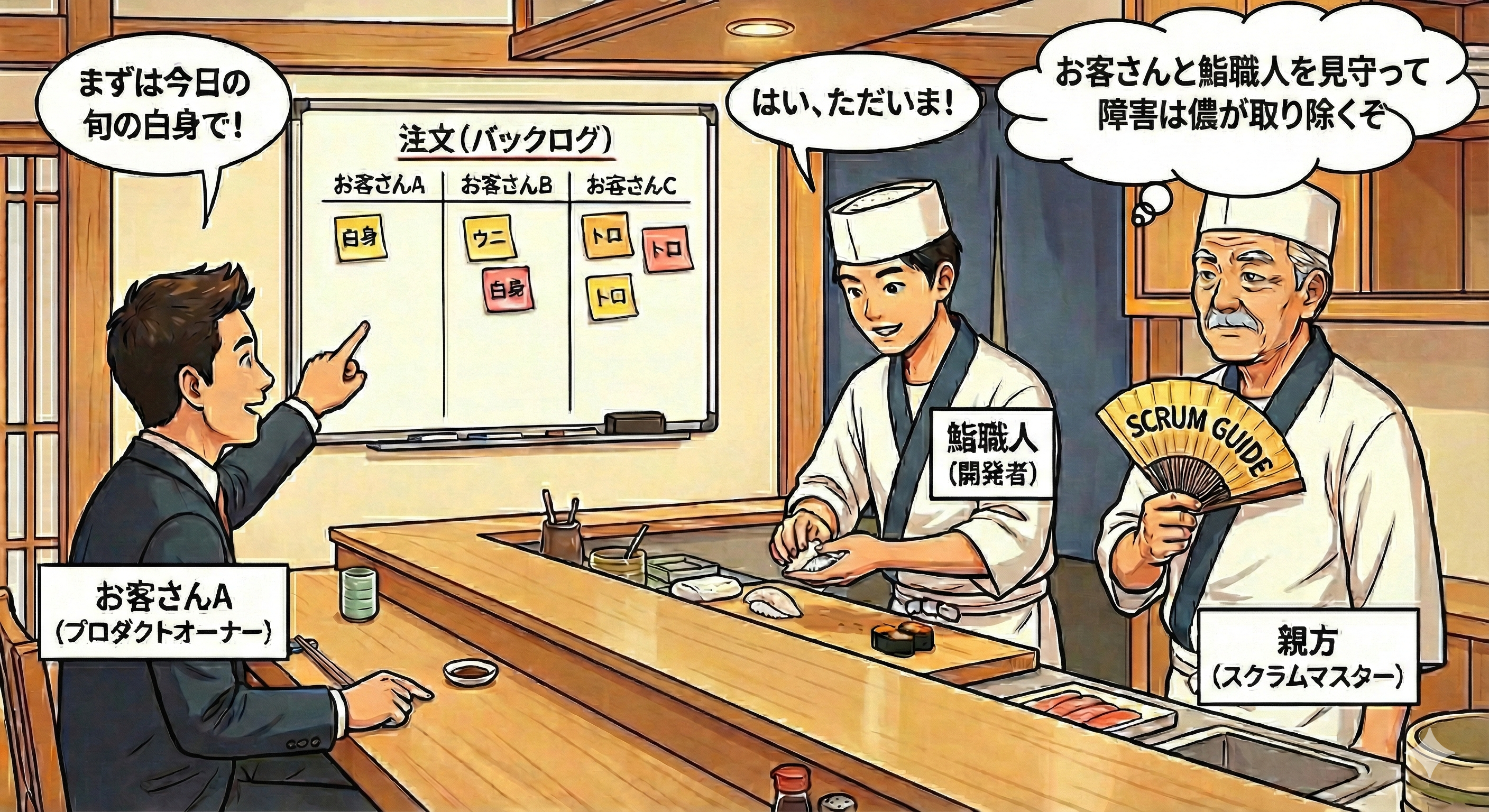
So what about when you sit at the counter? The conversation starts with “What would you like to drink?” then “Today we have wild flounder fin,” and you reply “In that case, salt-seared, please,” while glancing at the fish display case. You order in the order and timing you want to eat, and when you’re full and satisfied, you can say “I’m done” anytime♪ If it’s disappointing, you can leave early.
Other guests are each savoring their favorite sushi. The sushi chef behind the counter listens to the orders of several customers around them and basically serves in the order received, although orders that require searing or take extra time may get interleaved. But for some reason, there’s rarely any dispute over that. I think a big reason is that the chef’s situation is entirely visible (visualized) to the customers. Of course, audible transparency also works—you wouldn’t barge in and place an order while another customer is still ordering, right? (Self-imposed mutual exclusion?)
When you hear another customer say, “This uni is delicious~,” you want some uni too, and if you see the display is running low on toro salmon, you might decide to skip the kan-buri you were going to order next and order the toro salmon instead… Your priorities naturally shift one after another~
The customers eat at their own pace, and the chef works at their own pace. They can probably handle about three to five customers at a time. While things may get slightly out of order due to ingredient availability, the sequence of orders is still quite important. Each customer has their own product backlog, and the chef merges them in chronological order when preparing the sushi. Orders for items like red miso soup, tea, or alcohol are often brought asynchronously by staff other than the sushi chef.
The customers placing orders are each Product Owners. The sushi chef preparing them is the Developer. The master (shop owner) is like the Scrum Master, you could say.
(If you want to scale up the restaurant, you could add more in units of “5 counter seats & 1 sushi chef”—would that be large-scale agile?)
What Determines Whether You’ll Think 'I Want to Eat Here Again'?
#Of course the taste of the sushi matters, but so do the price, the atmosphere of the restaurant, the sushi chef’s behavior—all aspects of the customer experience have an impact, right? Fresh ingredients and clean, sanitary kitchen tools and tableware are a given, but quality is also the “perceived value” of the sushi you ordered being tastier than expected.
What should the sushi chef be particularly careful about?
Hygiene: preventing food poisoning, maintaining personal appearance, etc.
Customer service: language and behavior ensuring guests have a comfortable experience.
If you’re near a tourist spot, it’s probably good to be able to provide some tourist information in English as well.
And of course the cooking skills and dignity befitting a sushi chef at the counter.
But What If There’s a Master Who Meddles Excessively Between Customers and the Sushi Chef?
#What would the master be concerned about? Would it be that each piece has 360–370 grains of rice? Would they snatch away the flounder nigiri that the sushi chef placed before the customer, saying “I’ll just inspect it to see if it’s okay to release,” and count the grains of rice? Would they want to use a microscope to check each piece in front of the customer and say, “There are no bacteria. Please enjoy with confidence”? Would that really make customers feel at ease? Mightn’t it actually make them feel more uneasy?
What Should the Master Actually Be Doing Right Now While the Sushi Chef Is Making Sushi at the Counter?
#Of course, compliance with the Food Sanitation Act, the Food Labeling Act, standards for fishery products, labor safety and health regulations, and so on is required. And since June 2021, hygiene management in line with HACCP has also been mandatory. Since sushi restaurants handle raw fish, the risk of food poisoning is especially high, so thorough hygiene management is essential. But the quality of the customer experience is also important, isn’t it?
If we break it down into something like a Definition of Done, Definition of Ready, and Acceptance Criteria, it might look like this:
-
Definition of Done (Quality Standards for the Entire Restaurant)
Legal and Safety Standards
Compliance with the Food Sanitation Act: kitchen hygiene, employee health management, ingredient storage temperatures.
HACCP Compliance: hazard analysis and control standards for each process.
Allergen and Ingredient Labeling: mandatory information for takeout and delivery.
In-Store Experience (User Experience)
Clean counters and utensils.
Graceful movements of the sushi chef, creating a calm atmosphere.
Serving timing aligned with the customer's pace. -
Definition of Ready (Conditions to Be Met Before Starting to Prepare Nigiri)
Ingredients are stored at specified temperatures.
Cooking tools are cleaned and sanitized.
The sushi chef has washed their hands and confirmed hygiene.
The order details are clear, and the customer’s preferences (such as with or without wasabi) are confirmed. -
Acceptance Criteria (Quality Standards for Each Sushi Topping)
A concept similar to “acceptance conditions per user story.”
Each customer’s expectations for a topping vary, but what’s important is to what extent you can exceed those expectations.
It’s difficult to quantify “deliciousness” numerically. Even with the same sea bream, it varies by origin, season, and individual fish...
Sea Bream (White-Fleshed Fish)
Freshness: has translucency and elasticity.
Temperature: refrigerated at 0–5°C.
Cutting: a beautiful cross-section that highlights the muscle fibers.
Eel
Heating: core temperature of at least 75°C for more than 1 minute.
Sauce: an even glaze without being over-charred.
Serving: served while still warm.
Sea Urchin
Color: vibrant yellow to orange.
Aroma: scent of the sea, no off-odor.
Presentation: carefully arranged so it doesn’t collapse.
Cleaning the interior and preparing the rice and fish is, of course, completed before opening the noren curtain, but as time passes after opening, replenishing ingredients and giving the sushi chef breaks also becomes necessary. Even in ordinary restaurants, many people find it unsettling when the owner loudly directs the staff, and in a calm, quiet sushi restaurant that effect is even more pronounced, right? A skilled sushi chef knows what to do once they understand the situation. So all you need is to make the situation “visible” to them. If they don’t know what to do at the moment, the master will handle it on the spot and then hold a review meeting after closing.
The master quietly observes the state of the restaurant with eyes and ears, communicates with the sushi chefs through subtle glances and unobtrusive actions, in perfect unspoken harmony, and continually makes adjustments to ensure a better customer experience. As I wonder if the delicious sake also contributes to this comfort, I feel full. Thank you for the meal♪
Conclusion
#Sushi is popular overseas as well. It’s said that becoming a full-fledged sushi chef requires more than ten years of apprenticeship, but recently, regardless of age or gender, you can efficiently acquire skills in a specialized school in a short period. Here too, the principle of the "Constructal Law," which describes evolution toward better flow, seems applicable. On top of solid techniques, chefs freely come up with improvements to further satisfy customers, and that feedback comes back in real time. No one can take away the freedom to keep seeking better ways.
Watching customers happily eat sushi crafted by the chef at the sushi bar counter makes me think about agile in many ways. It’s almost 2026. I hope it will be a better year for all of you!