Recommendations for Walking: The Results of a Remote Worker with Zero Exercise Habits Walking 12,000 Steps a Day
Back to Top
 アドベントカレンダー2025
To reach a broader audience, this article has been translated from Japanese.
You can find the original version here.
This is the Day 25 article of the Mamezou Developer Site Advent Calendar 2025.
Note: This is not a tech-related article.
I’m Ishihara, who watches my diet yet still eats a Burger King Whopper once a week.
Hey developers, are you walking?!
This article is aimed at those of you who can relate to the following in your daily lives:
- Your work is remote.
- You spend most of your time at home on days off.
- You have no particular exercise habits.
- Your average daily steps are under 1,000.
- You love eating junky, delicious foods.
- You have the desire to “move your body,” but can’t take action.
These were all me until a few months ago. Now, as of December 2025, my lifestyle has changed as follows:
- I consistently walk 12,000 steps every day or do strength training at the gym.
- Walking no longer feels like a chore.
- I now naturally pay attention to total calories and PFC balance in my diet.
- I have lost 2 kg.
- My appetite has increased further in a healthy way.
In this article, I’ll describe how I came to experience these changes and share some stories with those of you who have the same dilemma of “I want to exercise but can’t take that first step.”
The Catalyst Was Vitality
#At the end of September 2025, I received a company-wide announcement from General Affairs inviting participants for the “Vitality Program.” It seemed to be an attempt to introduce an external service as part of corporate health management to promote employee health.
I originally wanted to “move my body,” but I had no trigger to get moving. What really pushed me was this one line in the announcement:
"We will hold a ranking award ceremony and plan to give out luxurious prizes at the year-end party!"
The moment I saw that, I thought, “I’ve got to do it!” I signed up immediately, and in October 2025, my walking journey began.
What Is Vitality?
#It’s a health promotion program offered by Sumitomo Life Insurance, and Mamezou adopted the “Vitality Smart Program (Employee Benefits Type).”
[Note]
I’m not writing this as a PR piece, but according to insiders, Mamezou was Sumitomo Life’s first customer for the “employee benefits type.” There had been pilot implementations in some departments, but this was the first company-wide rollout.
I’ll defer the details to the official website, but simply put, it’s a system where you measure your steps and heart rate via an app to earn points. Depending on the points you accumulate, you can receive the following weekly rewards:
- 500 yen Starbucks coupon
- 500 ml bottled tea from convenience stores or Lawson’s drinkable yogurt
- Donations to various organizations, and so on
The maximum points you can earn daily (excluding events) is 60 pt. The conditions for earning are as follows. (Only the highest scoring condition applies; you cannot stack points.)
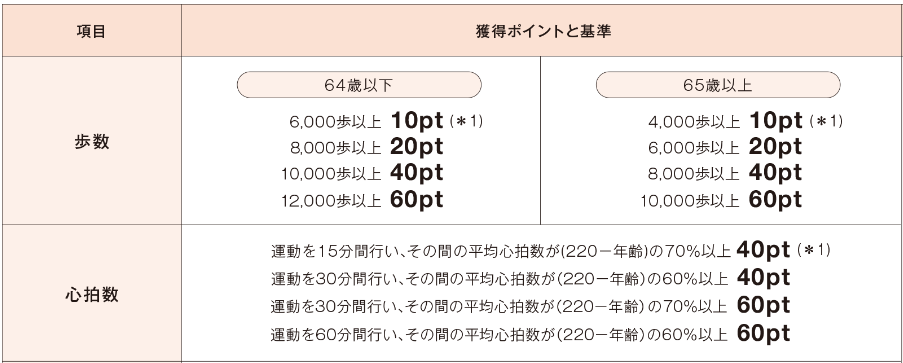
My goal was simple: “As long as I nail 60 pt every day, I should rank!” With that belief, I started pursuing “60 pt a day” until the December year-end party. (I ended up earning them almost entirely by walking roughly 12,000 steps.)
Internal Initiatives
#At Mamezou, we created a dedicated Slack channel for Vitality participants and regularly announced the rankings there. For the ranking names, those who wanted could set a nickname, so I registered as “Beer tastes best after sweating 🍺.”
Gear I Prepared
#To break out from just 1,000 steps a day, I’ll introduce the “Three Must-Have Items (+α)” that I actually acquired.
1. Smartwatch (Wearable Device)
#You can measure steps with a smartphone, but you cannot measure heart rate. Considering Vitality point efficiency, doing 30 minutes of high-intensity exercise (elevated heart rate) is overwhelmingly more time-efficient than racking up steps. (30 minutes yields roughly 4,000 steps; you’d need 1.5 hours to hit 12,000 steps.)
I was originally in the camp of “I don’t need a smartwatch,” but once I started wearing one, my activities became visible to me, which greatly helped maintain my motivation. I strongly recommend it to those who haven’t adopted one yet!
2. Running/Walking Shoes 【Most Important】
#It’s hardly an overstatement to say that this is the most crucial investment. When someone who is out of shape walks long hours in standard sneakers, there’s a high chance of injuring their feet and lower back (speaking from experience). Modern shoes offer amazing cushioning, so first and foremost, get a proper pair. Here are the shoes I personally purchased:
- Fresh Foam X 880v14 GORE-TEX® (New Balance)
Since they’re black sneakers, you can use them daily. The GORE-TEX material keeps your feet comfortable even in sudden rain. - Cloudmonster (On)
The cushioning is out of this world. It feels like “walking on clouds,” so I wholeheartedly recommend these for anyone planning to walk long distances.
3. YouTube Premium
#It’s a magical tool that transforms your walking time from “exercise time” to “entertainment time.” Because it allows offline playback and background playback, you can walk while listening to videos without worrying about data usage.
Tips: If you enable the “Smart Temporary Save” feature, new videos from your favorite channels will be automatically downloaded, so you don’t need to prepare anything before leaving home.
4. Other Accessories
#- Hat: A reliable companion that hides the messy hair you wake up with. Since they can get stuffy, choose one with good ventilation.
- Clothing that allows free movement: Basically, anything works, but having a light outer layer makes it easier to regulate your body temperature, and it’s convenient because it doesn’t take up space even if you take it off.
- Wireless earphones: For watching/listening to videos. However, on narrow sidewalks, for safety, use “one-ear listening” or “ambient sound mode.”
Tips for Walking Every Day
#After walking over 10,000 steps almost every day for two months, here are the tips I found for making it a habit.
1. Turn Your Video-Watching Time into Walking Time
#Good news for those of you who usually spend over an hour watching videos at home. Turn that time directly into walking time. By using features like YouTube Premium, download videos in advance and just listen while you walk—and before you know it, your walk is complete.
At first, I thought, “Wouldn’t I need to watch the screen to enjoy it?” but I found there are surprisingly many contents that are satisfying with just audio. When you find a video that interests you, instead of watching it on the spot, download it and listen while you walk.
2. Don’t Hesitate to Invest in “Shoes”
#Do you think, “If it’s just walking, my regular shoes are fine”? I made that mistake. As a result of starting to walk in non-specialized sneakers, the following happened:
- Physical failure: The outsoles on two pairs of sneakers peeled off in just two weeks.
- Body glitch: I experienced pain around my Achilles tendon every time I walked.
The most important hardware for sustaining the task of “walking” is your shoes. Believe me, get yourself one pair of comfortable walking/running shoes. That alone will dramatically boost your consistency.
3. Lower the Difficulty by “Splitting” It Up
#Trying to walk for a full hour at once is a high hurdle, but if you split it, like “30 minutes in the morning, 30 minutes at night,” the mental burden drops significantly. Especially morning walks help reset your internal clock and improve sleep quality, so I especially recommend them for engineers’ health management (though they require some grit on winter mornings!).
4. Walk in Different Places
#Walking your favorite route every day can be nice, but sometimes walking somewhere else can lead to new discoveries and insights, which is great.
- Promenades: If there’s one nearby, it’s the No.1 route I want to try first. It feels like a child discovering a new hideout.
- Train stations (especially those you don’t usually walk to): Walking to a slightly distant station lets you encounter unfamiliar streets. The realization of “It’s actually closer than I thought” expands your travel options.
- Large shopping centers: Places like Aeon, Costco, outlets, etc. You can enjoy window shopping while walking.
- Parks, shrines, temples, etc.: Spots where you can feel the seasons also have a positive effect on your mental state.
5. Try Changing Your Walking Speed
#When you become accustomed to walking, varying your speed can be fun. Naturally, increasing your speed increases the physical demand, but simply tinkering and thinking about how to walk faster and more effortlessly while you walk can greatly lessen monotony.
6. Walk Even on Rainy Days
#Aside from severe storms, if it’s just light rain, you can walk without an umbrella by wearing water-repellent clothing. (GORE-TEX shoes are also a good choice.) Also, even on a rainy day, rain intensity fluctuates, so by checking the weather occasionally and walking when it eases up, you might be surprised by how much you can still walk. If it’s absolutely impossible, stay home and do strength training or aerobic exercise. (I used to pedal an exercise bike at home.)
Benefits and Drawbacks Experienced After Starting Walking
#Benefits
#- My physical strength has dramatically improved (raising my baseline stamina).
In the past, just going to the office occasionally had me feeling like “only 30% HP left” by midday. But recently, even being crammed in a crowded train doesn’t fatigue me as much. - Measurable physical changes: I lost 2 kg; my VO2Max (maximum oxygen uptake) rose from “below average” to “above average”; and my resting heart rate decreased. It appears that “just walking” can indeed train your cardiovascular fitness.
- Increase in activity volume: I dedicate 1–2 hours a day to walking, but with my increased stamina, I have more active time overall. I can now enjoy active weekends like “cycling to Enoshima in the morning → a public bath after returning home → an evening walk,” feeling like I get more bang for my time.
- Improved sleep quality: My formerly irregular daily rhythm normalized, and I now naturally fall asleep at night.
- Increased ‘resolution’ of my neighborhood.
One of the pleasures is discovering local scenery I had overlooked until now. In fact, while walking to the next station, I happened to come across the opening of a new gym, which became the reason I started strength training.
Drawbacks
#- Increased expenses
Once you start stocking up on shoes and apparel, the things you want to be particular about keep multiplying. And as your range of activity expands, your gadget wishlist grows, so the hit to your wallet can be quite heavy (though I’m happy about it myself!). - Achilles tendon pain
My recent concern is Achilles tendon pain at the beginning of a walk. It subsides when my body warms up, but coldness and accumulated fatigue also seem to play a role. I’m tweaking my shoes and form, but I keenly feel that “proper rest” is also an important task.
Epilogue
#As a result of walking 12,000 steps every day, I ranked a splendid 2nd place at the year-end party! The luxurious prizes I received are below:
- Vitality towel
- Vitality multi-large bag
- Blanket with “SUMITOMO” lettering
- [Participation Prize] Mamezou original squeeze bottle (Personally, this was my favorite)
These are almost entirely stuff I received from Sumitomo Life...
The walking habit I acquired might have been the greatest prize of all.
Just when I thought I’d dial back my walking after the year-end party, someone from the company invited me, and I decided to participate in the 12th Tokyo Extreme Walk 100 next May! Since it’s a grueling competition where participants walk 100 km from Odawara to Tokyo’s Ariake within a 26-hour time limit, I want to prepare to walk even more than I do now.
There’s still time (by the way, it’s my first time), so if you’re interested, let’s tackle it together!